Saturday, July 14, 2012

Learning to See Through Blind Woodworkers


Yesterday I received an email and a link to a U-Tube video from an old acquaintance, Larry Martin, who was instrumental in starting an organization called Woodworking for the Blind. The video is pretty amazing; check it out HERE.
His email jogged my memory about a chapter I wrote in my book, A Splintered History of Wood, a few years back. Part of the writing focused on Larry’s work. There were a number of sight-impaired woodworkers who were having difficulty gleaning the needed information on woodworking projects from books and magazines. He began reading and recording CDs containing information on the projects. He also made himself available via phone to answer questions that sight-impaired woodworkers might have. He did all of this because, well, he’s just a nice guy. Click HERE for more information on the Woodworking for the Blind.
Larry directed me to three sight impaired woodworkers who I interviewed over the course of one long, amazing afternoon. I talked with David Albrektson who loves making furniture.

David Albrektson with his hollow mortise machine

 And Ron Faulkner who gravitates toward cabinets and dovetailed boxes
Ron Fualkner with a few of his decorative boxes

And Gordon Mitchell who not only enjoys building furniture, but built his woodworking shop and a house to go along with it. 
Gordon Mitchell at work in his shop (that he built!)

When I hung up the phone, I realized I hadn’t heard one utterance of “poor me,” only words of thankfulness and positivity. Wow. Turns out, these woodworkers are no different than any of the rest of us. We all savor the touch and warmth of wood. We all experience highs and lows. We all make mistakes. We all love to innovate out way through problems. We all enjoy the fellowship of other woodworkers and savor the solace that comes when working alone. And that’s what makes woodworking the best pastime of all.

Thursday, June 21, 2012

Norm Sartorius—Spoon Maker Extraordinaire


Six times a year I write “The Great American Woodworker” column for American Woodworker magazine —which means I get to interview six truly unique, talented woodworkers every year. For my next few blogs, I’m going to briefly introduce you to a few of these amazing woodworkers.


Norm Sartorius in his shop
Today you get to meet spoonmaker, Norm Sartorius. Though his area of expertise may seem quirky, it’s served him well. He’s been able to make a living plying his specialty craft for over 30 years and currently has spoons in the Museum of Art and Design in New York City, The Smithsonian, the Carnegie Museum of Art and dozens of other private collections and galleries. Some of his spoons sell for as much as $4,000.
         One of the reasons he loves making spoons is that the design possibilities are endless—his work will attest to this. During the interview Norm explained, “Spoons are an infinite category. You can make thousands of them and no two are the same. I still have fun making each one.”

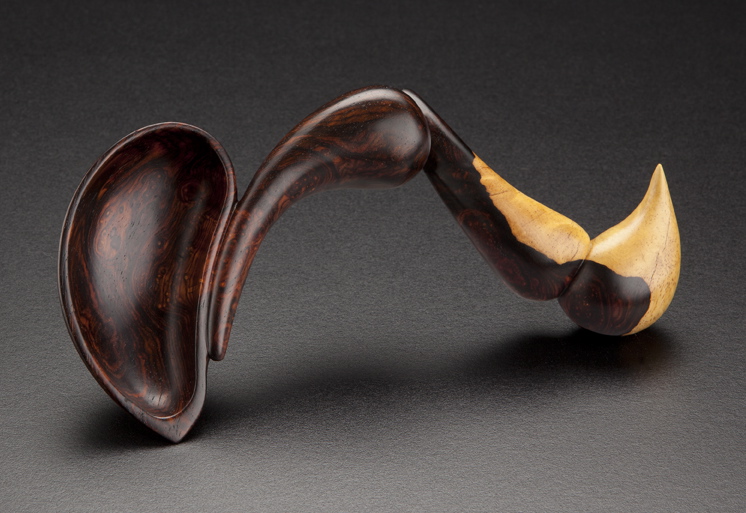
Spoon made from Paela Burl (photo by Jim Osborn)
He’s used woods from a tree planted by George Washington, from the famed. fallen Wyatt Tree, and from woods that people from around the world have sent him. He’s used 5,000-year-old river gum, exotic amboyna burl and mystery woods found in the desert.

Spoon crafted from cocobolo wood
In most cases he lets the shape and grain of the wood determine the size and shape of the spoon he’ll craft from it. Once the wood speaks to him, he does the initial roughing out using bandsaws, die grinders and pneumatic sanding drums, then switches over to scrapers of every shape and size (dental picks included) and sandpaper.
His spoons aren’t for stirring soup, but rather to “stir the soul.” See what you think. To see more of his work, visit  Norm's website

Spoon crafted for folksinger Pete Seeger. "Art or not, Pete told me he was going to use it," explains Norm.

Thursday, June 14, 2012

A SIMPLE GIFT FOR FATHER’S DAY


A simple gift for dad—anyone can build it

Last weekend I was at Valley Bookseller Visit Valley Bookseller in Stillwater promoting Woodworking FAQ: The Workshop Companion, and other books I've penned, for Fathers’ Day. I was promoting something else, too—the idea of building something with your own two hands to give as a gift. We weren’t just promoting the idea, we were building it! I think the good folks at the bookstore are still vacuuming up sawdust
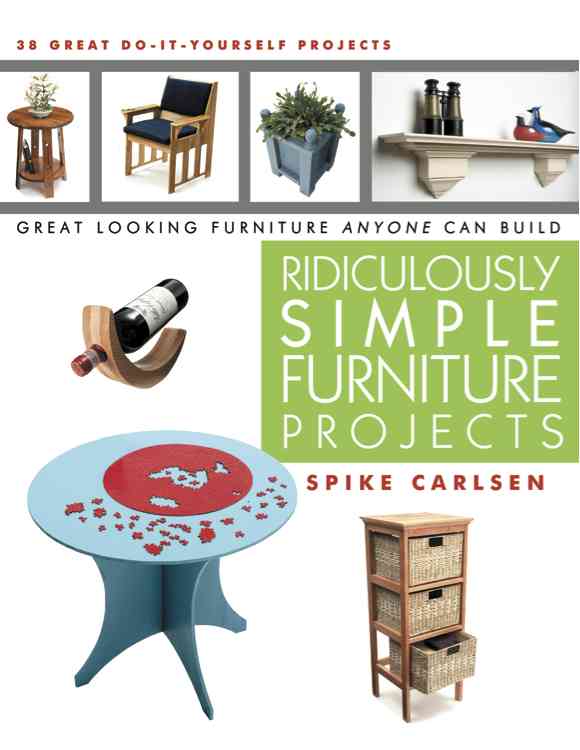
The book that features the project

The project was a simple balancing wine rack featured in my book, Ridiculously Simple Furniture Projects. All it really takes to build one is a drill, a jigsaw and about 30 minutes. I think these things are so cool people should make them by the dozen to have on hand for emergency gifts! And there are a jillion variations in terms of shape and size. It's a great project for using up oddball wood scraps.

My granddaughter Paige sanding her project

There were kids of all ages building the racks during that hour; a couple of 60+ years olds that wanted to dip their toes into woodworking, a pair of Junior High girls that unwittingly walked into the scene and wound up making gifts for their dads. They rolled their eyes a little, but in the end they thought it was cool. There were little kids ranging from 1 to 7 years old. Best of all, three of my granddaughters and four of my own daughters were there. Guess what I got for Fathers’ Day?

Daughters Kellie and Tessa building a bottle rack for dad

         It’s pretty easy to walk into a store and buy a card and a necktie—but it’s not much harder to make a simple gift. With a handmade gift comes the memories of making, giving and receiving it. It feels better. Give it a whirl.

Here's the basic plan::
A simple plan for a simple project. Just build it!


Thursday, June 7, 2012

RIPPING BOARDS WITH A MACHETE (& OTHER TANZANIAN MEMORIES)


About every two years I head over to Tanzania for a couple of weeks to work alongside the students and staff at Bomalong'ombe secondary school to improve their water and electrical system and to help build dorms and classrooms. Last time I was there I promised the school carpenter—a gentleman by the name of isaak—that I'd get some hand tools over to him. I can’t go this time, but while I was packing up tools for the group going over there to take, I began reminiscing about the day I spent building chairs with Isaak.
Isaak and students working on chair components

Power at the school is scarce, so Isaak does all of his work with hand tools. The morning I arrived to apprentice with him he explained that our first task was to rip the material we needed for the chairs down to the proper width. With that he broke out a machete and in 6 or 7 deft strokes “ripped” the chair legs to the exact width needed. The blade came within fractions of an inch to his fingers, but he was so skilled he never even flinched. When it came time for me to “rip” some material to width, it took me 10 times as long.
Spike cutting tenons using a box miter saw

The day involved much sharing of information, much laughter and much building. The workbench was a rickety old table with crossbracing. We used planes to plane; brace, bits and chisels to create the mortises; saws and chisels to create the tenons; draw knives to create the scooped seats and curved backs. By the end of the day, Isaak had created five new chairs and left an indelible impression upon me. What was impressed?
Isaak proudly displays one of  five completed chairs

           
1)    That having the right skills trumps having the right tools
2)    That every woodworker has things to learn from every other woodworker
3)    That woodworking is a universal language.

For more information on Mission Tanzania, visit Mission Tanzania, Trinity Lutheran Church

Wednesday, May 30, 2012

BIG TREES, BIG WORK (and no more whining)


I was bemoaning how sore my arm was the other day after pruning branches from the silver maple tree in our side yard. Some of them were as big around as my thigh. There's something about hand sawing that takes it out of a guy.

And then I ran across these photos a friend sent a while back. Think of the sore arms and backs and everything else that resulted from "pruning" these babies. My arm doesn't feel so sore now.

If these guys are 6 ft. tall, this tree is 18 ft. in diameter
One tree, one trainload


Uffdah!


Wednesday, May 16, 2012

PlyDesign: Never look at a sheet of plywood the same way again!


About a year ago I was asked by fellow author and woodworker, Philip Schmidt, if I’d like to contribute a project to a book he was working on. I replied with a resounding “YES!” The book, PlyDesign: 73 Distinctive DIY Projects in Plywood, is now out and it’s a stunner. Not so surprisingly, it contains 73 distinctive projects crafted from plywood. But this is no ordinary book and these are no ordinary projects. It gives one a new appreciation of the versatility of plywood—and those that work with it.


         There are laptop desks, bookshelves, chairs, dining room tables, candle holders, toolboxes, skateboards and “Drunken Monkey” wine racks,
         A few of my favorite projects are:
         * The One-Sheet Table and Benches—A contemporary trio of furniture pieces that are attractive and functional when in use and nest together neatly when not.
         * Light Within—A space age-looking light fixture made of plywood and vellum paper.
         * Mudroom Organizer—a heavenly host of cubbyholes for shoes, backpacks, hats and everything else that usually winds up on the floor.
         * And of course, the Bowlegged Plant Stand, designed by yours truly. The design was inspired by a Craftsman-style table I ran across a few years ago.

The Bow-Legged Table as it appears in the PlyDesign (page  89)


The inspiration for the Bow-Legged Table (plus the author's  "how it goes together" doodle)

 In the spirit of full disclosure (and shameless self-promotion), the book was published by Storey Publishing—the same great folks responsible for my most recent book, Woodworking FAQ: The Workshop Companion. These two books are one of their first forays into the world of woodworking and they’ve done a stunning job.

         Check out PlyDesign; you’ll never look at a sheet of plywood the same way again.

Tuesday, May 8, 2012

IS IT A DECK OR A PIANO?


The first builder I worked for had a little quip he’d toss my way whenever he thought I was being a little too meticulous (i.e. working too slow.) The quip was “What are you building—a _______ or a piano?” It didn’t matter if he filled in the blank with the word “garage” or “wall” or “deck,” the meaning was clear: He didn’t want me wasting major time on minor things.
         For the past week or so I’ve been laying the decking for our new deck. And a few times I’ve wound up asking myself, “What are you building here, Spike—a deck or a piano?”  You see, these are no ordinary deck boards. After a fair amount of research and soul searching (and credit card searching), Kat and I decided to go with Ipe.


Ipe is amazing stuff. It isn’t so much a single tree species, as a group of closely-related trees with similar characteristics. The trees, common to Central and South America, grow to 160 ft. in height and 6 ft. in diameter. The wood is FSC certified.
         With a hardness rating three times that of oak, so heavy it sinks and carrying a Class A fire rating (the same rating as concrete and steel) it’s earned its nickname “ironwood.” It’s so durable it’s used on the well-trod boardwalks of Coney Island, Atlantic City and other iconic walkways. Since it has a projected lifespan of 25+ years, I’ll be 85+ before I have to replace it again! All this beauty and function comes with a price tag—it runs about $10 per board foot.


It’s so beautiful—the wood is literally furniture quality stuff, with bloodlines similar to that teak—one really doesn’t want to muss it up with pairs of screws through the face of it every 16 inches. So I’ve been using hidden fasteners that slip into grooves along the edges of the boards and then secured to the joists. So not only does the wood cost 3 or 4 times as much as the alternatives, it takes 3 or 4 times as much time to install the stuff. So this deck is part-deck/part-piano. Which is fine—as long I puts myself in a piano-building mode.

In the end, this deck (and my attachment to it) will take the course of most of my other woodworking projects: I’ll beat my chest with pride and joy as each tight fitting joint is created. I’ll stand back and soak in the beauty of the finished piece. Then I start taking it for granted. But those early moments of joy and working with my hands make it all worth it. Woodworking is the best of two worlds—it’s both a journey and a destination.